Typhoon Champi Kills One and Injures More Than 500 in Taiwan: Hundreds of Thousands of Homes Lose Power, Hundreds of Flights Cancelled
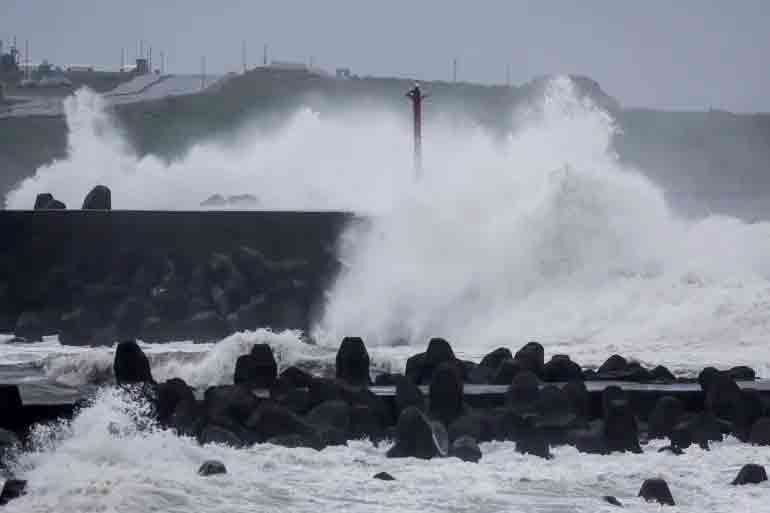
One person has been killed and at least 527 injured as powerful Typhoon Champi struck Taiwan. The storm cut power to more than 288,000 homes across the island, causing widespread damage as it passed along the north-eastern coast on Friday and Saturday.
Champi, which grew into a super typhoon, has been described as one of the strongest storms in the Pacific region this year. It later weakened and turned north towards China's coast, although forecasters said it was not expected to make a direct hit on the Chinese mainland.
According to Taiwan's Central Weather Administration (CWA), the storm's centre was located about 170 kilometres north-east of the island on Saturday. Earlier, in the early hours of Saturday, Champi had passed just off the coast of Ilan County, crossing the island's north-eastern region.
Even as it weakened, gusts near the storm's centre reached about 126 kilometres per hour. Earlier, gusts in some coastal areas had reached up to 227 kilometres per hour, and at one point the typhoon's winds were reported to have risen to around 300 kilometres per hour.
Taiwan's fire department said the person who died was a resident of Liuqiu Island who was swept away by waves. At least 527 people were injured by the strong winds and heavy rain, and more than 4,300 people were evacuated from their homes because of the storm.
According to Taiwan Power Company, more than 288,000 homes lost electricity in the storm, although supply has since been restored to most of them. The transport ministry said 259 flights were cancelled on Saturday because of the storm, following around 1,000 cancellations on Friday, so the flight situation improved somewhat on Saturday.
Authorities across large parts of northern and central Taiwan, including Taipei, kept offices and schools closed for a second consecutive day. Residents were advised to stay indoors, while transport was disrupted and shops and educational institutions remained shut because of the storm.
CWA forecaster Lin Ping-yu told a news briefing: 'From tonight until tomorrow morning, there will be very gusty winds and stormy weather everywhere. Please try to stay indoors.' The weather agency also warned that the storm's effects could be prolonged.
Forecasters said Champi could bring up to 900 millimetres of rain to Taiwan between Thursday and Saturday, with the north-east at greatest risk. More than 400 millimetres of rain fell in Ilan County on Friday. Another CWA forecaster, Lu Kuo-chen, said the typhoon could slow down near Taiwan's north-eastern tip, prolonging its impact on the island.
Champi also disrupted power supplies in Japan's Okinawa islands. Okinawa Electric Power Company said about 8,400 homes there were without electricity as of Friday afternoon. Forecasts suggest that after passing near Okinawa, Champi will move along China's east coast before turning north-east towards southern Japan.
As Champi approached, Chinese authorities also stepped up preparations. China's emergency management ministry sent a team to the eastern province of Zhejiang, where strong winds and heavy rain were expected through Sunday. A total of 400 rescue workers and 600 pieces of equipment were placed on standby, along with more than 41,000 firefighters on emergency duty. In the coastal Zhejiang city of Taizhou, more than 3,800 fishing boats returned to port, workers at sea fish farms were brought ashore, 2,084 tourists were evacuated from islands, work was halted at 25 coastal construction projects and 18 passenger ferry routes were suspended.
Typhoons are most common in the Pacific region in summer, but such storms can also strike in autumn. The role of El Nino in this season's increasing storm intensity is also under discussion. The United Nations said on Wednesday that El Nino, the natural climate cycle that warms tropical Pacific waters, is becoming unusually strong. World Meteorological Organization Secretary-General Celeste Saulo said the current El Nino conditions could be unprecedented in strength. El Nino is expected to peak in December this year, and its effects could continue into 2027 and beyond.