After Amphan Took Their Homestead, Satkhira Couple Shahjahan and Rabeya Live Alone in a Canal-Side Hut
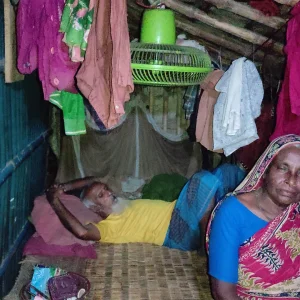
Shahjahan, who is over seventy, and his wife Rabeya Begum, who is over sixty, sit quietly in front of a small hut on the bank of a canal created by tidal flooding at Hawladar Bari in Pratapnagar Union of Ashashuni upazila, Satkhira. There is a vast expanse of water all around them, but because of its salinity that water cannot be used for anything. Rabeya Begum gazes at that water from their worn-out shelter, her husband, bent with age, beside her.
There was a time when the couple had a full household in this very home. Their life was a happy one, with a green mango orchard and paddy fields on two bighas of land and a tidy homestead.
In May 2020, super cyclone Amphan destroyed everything. The embankment next to Kurikahunia and Hawladar Bari in Pratapnagar Union broke, and saline water from the Khulpetua and Kopotaksha rivers rushed in and quickly washed away the household they had built over many years. For several years after that, their home was flooded by the tides every day, and the Khulpetua river swallowed their homestead and farmland.
Amphan did not only take their home, mango orchard and farmland; it also took the company of their relatives. As river erosion and long-lasting saline water cost them their homestead, their sons left the area in search of work, taking grandchildren Humayun Kabir, Mariam and Afroza with them. Rabeya Begum, who is ill, says she misses her grandchildren, but they have gone far away to find work, and at this age she and her husband do not know where they would go. Everything was here before, and so were their relatives; now there is no one, and she has to cook alone month after month.
Shahjahan Ali says Rabeya's father owned nearly three to four hundred bighas of land, and the girl who was born with every comfort is now destitute because of the saline water. Because of illness he can no longer work as he used to. What their son sends is not enough to run the household, and they pass their days sometimes going without food. A few days ago he fell ill at the market and other people carried him home. In his words, he no longer likes this lonely life.
According to environmental researchers and specialists, the current crisis in Satkhira's coastal region stems from the long-term impact of climate change, rising sea levels and repeated natural disasters. Because of these causes, the fertility of the soil and the sources of fresh water in the region have gradually become saline.
According to Bangladesh's Soil Salinity Map 2024, out of 1,703,759 hectares of arable land in the coastal region, 1,155,980 hectares have become severely saline, which is about 68 percent.
Shamsun Nahar Ratna, a senior scientific officer at the Satkhira regional office of the Soil Resources Development Institute (SRDI), says salinity is usually lower during the monsoon, but reaches its highest level in the dry season, especially from November-December through June. Salinity in Satkhira's Khulpetua river, which was 22 to 25 decisiemens per metre in 2019, has risen to a maximum of 50 to 55 decisiemens in 2026. She says that as upstream river flow and navigability have declined, seawater is moving inland, while irregular rainfall and climate change are bringing saline water from below the soil to the surface. As a result, growing more than one crop on farmland has become impossible, pushing farmers towards fish or shrimp enclosures.
Government figures show that during super cyclone Amphan alone in 2020, about 2.5 million people in the country's coastal areas had to leave their homes. Data from the International Organization for Migration (IOM) and the Government of Bangladesh show that 4.96 million people are currently internally displaced inside the country because of natural disasters such as floods, river erosion and tidal surges. The World Bank has warned that without rapid, sustainable action against climate change, the number of internal climate migrants in Bangladesh could reach nearly 20 million by 2050.
According to a joint survey by Satkhira Municipality and the non-governmental development organisation Uttaran, the number of people displaced to the district town by environmental disasters is rising. The survey says 10,133 families have taken shelter in Satkhira Municipality over 22 years because of natural disasters. Of them, 84 percent lost their homesteads to river erosion, tidal surges and severe salinity and were forced to move to the town. The largest displacement took place between 2000 and 2009, creating dense settlements in slums including in the town's Ward No. 9. There, displaced people live in cramped makeshift houses, amid dirty and flooded roads and fragile sanitation.
The picture is the same in Gabura Union of neighbouring Shyamnagar upazila. Fazila Khatun of Gabura, aged 60, has lost her husband and is paralysed; her children have left the village in search of work. Fazila Khatun says they used to live by farming, but now there is only salt everywhere; let alone paddy, not even a vegetable plant survives, and they have to walk for miles for drinking water.
Environment worker and researcher Pijush Baulia Pintu says that from Sidr to Aila, Amphan, Yaas and Bulbul, a total of 11 to 12 disasters have struck this coast in the last five to seven years. In his words, unplanned shrimp enclosures and unplanned sluice gates have weakened the embankments so much that even a minor blow breaks them, letting water into settlements and flooding farmland with saline water. He says that in seven or eight places in Gabura, including Durgabati, Harinnagar, Singhartali, Gabura and Jelekhali, homesteads have disappeared into the river as the banks eroded.
Human rights worker Madhab Chandra Dutta, executive director of Swadesh, says the losses caused by climate change that cannot easily be measured in money are called non-economic losses in international terminology. Because of them, people's own culture, heritage, distinct identity, mental health, education and social bonds are being lost. In his words, global climate conferences and government compensation policies count only visible financial losses such as broken roads, embankments or ruined crops; these irreparable psychological, social and cultural losses remain outside the policy framework.