Few fish in the nets, but no shortage of joy: the fishing festival at Burir Bandh in Thakurgaon
Once, twice, three times — even after casting his net four times in a row, Parimal Roy found no fish. Each time he pulled up an empty net and stood disappointed, this resident of Kartiktala village in Bhulli upazila of Thakurgaon. Standing beside him with a bag in hand, Sujan Roy consoled him: 'Cast the net — this time a big fish will come up.'
At his friend's words, Parimal cast the net one last time. As he pulled up the net that had splashed into the water, two puti fish were found trapped in it. Even this small catch brought a smile to his face. That small scene itself shows that at the Burir Bandh festival, catching fish is not the only point.
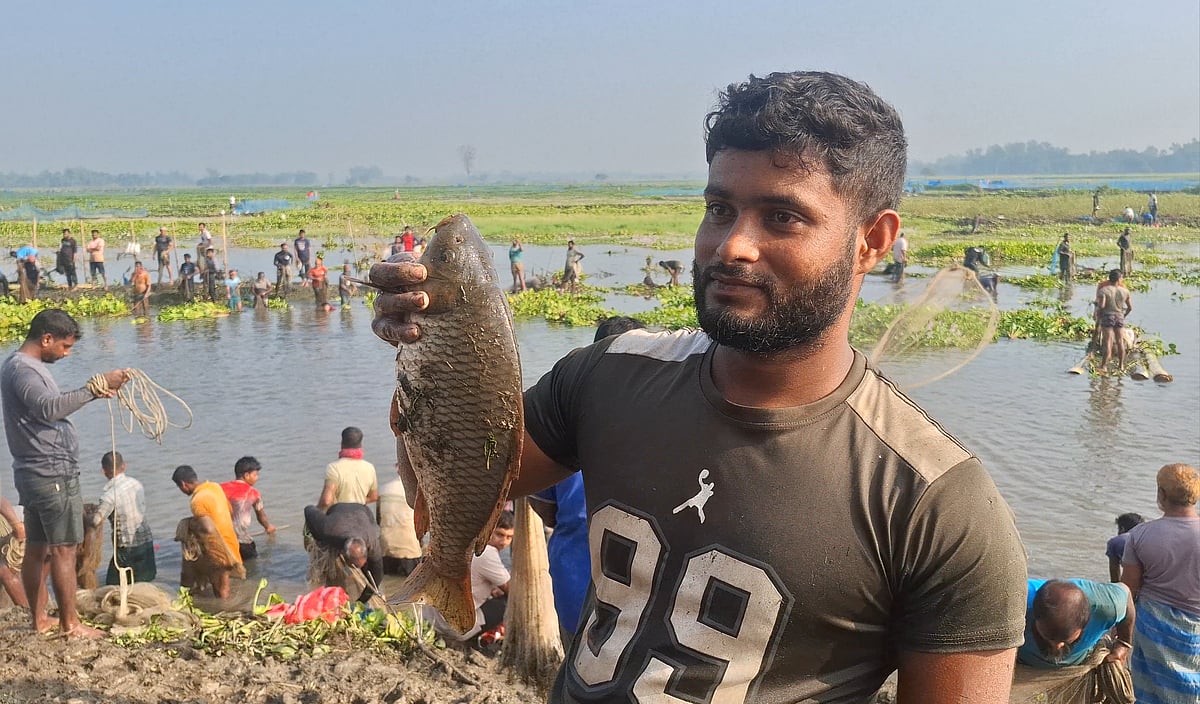
Whether fish are caught or not, for many people like Parimal, the joy of fishing at Burir Bandh (the sluice gate) on the Suk River in Thakurgaon Sadar upazila is not limited to the catch. Fishing in groups with friends and relatives, the banter, casting nets and seeing fish rise in them — together, all of it is a festival for them.
Last Friday, the darkness of night had not yet lifted. From all around in the half-light came splashing sounds. As a red glow slowly spread across the eastern sky, the source of those sounds became visible. Around the embankment, people of all ages were casting nets — some standing on the embankment, some wading into waist-deep water. Most of their nets were empty, but nobody's enthusiasm faded.
Talking to the Water Development Board (BWDB) Thakurgaon office and local residents, it was learned that the Burir Bandh irrigation project was undertaken in the 1951-52 fiscal year on the boundary of Akcha and Chilarang unions of Sadar upazila, to provide supplementary irrigation to farmland in the dry season. Holding back the embankment's water for irrigation was the project's main purpose. Later, in 1977-78, an 11.30-kilometre irrigation canal was built, through which 1,350 hectares of land receive irrigation.
Local people say the fisheries department releases fry of various native fish species into the water held back by the embankment every year, and the Burir Bandh Water Management Association looks after those fish. Every year in the third week of October, the embankment's water is released and opened for fishing. Then the fishing festival begins among people nearby. The tradition has continued since the sluice gate was built, and the festival lasts two to three days. Usually the water is released in the afternoon after an announcement. At dawn, when the water recedes, people from nearby villages arrive with cast nets to fish, joined by people from different areas, including neighbouring districts.
Early yesterday, Saturday, it was seen on the spot that some people were returning holding one or two small fish after pulling nets from the river, while others were preparing their nets anew. As the sunlight grew, so did the crowd. Some were happy with a few puti fish, others kept casting nets again and again hoping for a big fish. The catch was small, but there was no shortage in people's joy.
Anwar Hossain (35) of Purba Begunbari village in Sadar upazila came to the embankment with three friends last Friday night to fish. Taking turns casting nets, they eventually tired. During a rest, Anwar said: 'I have been coming to this embankment to fish for four or five years. The day passes in fun and noise. I never get as many fish as I hope for in any year. Still I come. Here I meet everyone and can enjoy myself.'
Standing in knee-deep water at the embankment, Tapan Roy (29) of Raniganj in Atwari upazila of Panchagarh kept casting his net one after another. He spent three hours casting, and in that time his luck brought him about half a kilogram of small fish. He was happy with that. Asked why he comes to fish, Tapan said: 'Have I come here only to catch fish? There is joy too.'
Joyonto Barman (47) of Dhantala village in Baliadangi upazila grew breathless casting his net. Suddenly he set the net down and struck up a song — 'Pushing through water all day / I am only exhausted / Where is my fishing?' Some joined in with him. Stopping the song, Joyonto said: 'I will not catch fish any more. I have to go back home. Before returning, I will buy some fish.' Asked why, he said in a parody tune that his wife was waiting to cook a puti fish curry, but he had caught nothing, so he would buy fish to fulfil her wish.
While many were disappointed, a 'Japanese rui' weighing over a kilogram rose in the net of Yasin Ali of Ramnath in Ruhia upazila. Yasin said: 'Many people did not get many fish. I am very happy to get such a big fish.' On the other hand, Ramjan Ali (56), head teacher of a girls' school, said: 'At this Burir Bandh, rui, katla, boal, puti, shol, tangra, kholse and various native fish species were once found. The number of people coming to fish grows year by year, but very few fish rise in the nets.' Romoni Kanto Roy (63) of Akhanagar echoed him: 'Earlier, casting a net brought up so many fish. But now there are no fish.' He alleged that local people have spread current nets all around, trapping the fish so they cannot come out.
Around the fishing festival, food hotels and fruit, toy and cosmetics shops have been set up on the embankment. Temporary garages have been made for motorcycles and bicycles of people coming from outside. Fish traders have laid out their wares on the embankment, and some visitors are buying that fish to take home. Thakurgaon district fisheries officer Pradip Kumar Sarkar said fry are released into Burir Bandh's water every year in varying amounts and later opened for fishing, when a festival grows around it; this year too several hundred people gathered there to fish. On current nets he said: 'We regularly conduct drives against current nets.' BWDB Thakurgaon executive engineer Atikur Rahman said the embankment gates are opened every year and the area turns into a fair of reunion. Veteran teacher and writer Professor Montosh Kumar Dey said: 'For those who go there to fish, this festival is not limited to fishing; it is also an occasion to meet familiar people, build friendships with new people and share a piece of the joy of rural life.'