What Can Israel Really Do Alone in Iran? Analysts Deeply Doubt the Goal of Toppling Tehran's Government
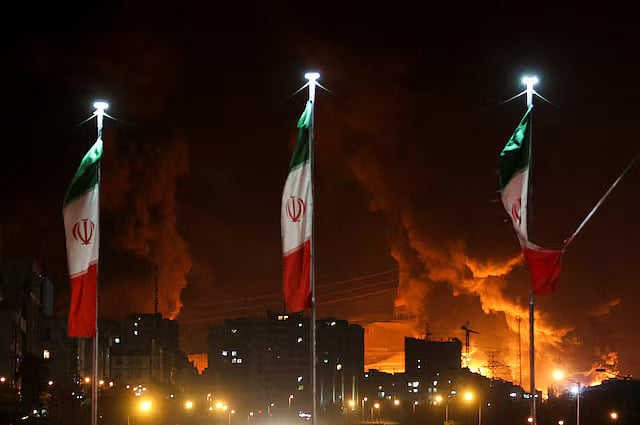
Iran has already survived two rounds of attacks and come through standing. The country still retains the ability to strike back — not only against Israel, but also against its Gulf neighbours, where United States military installations are located. Against that backdrop, a pointed question is being asked: what can Israel actually achieve in Iran on its own?
Israeli Prime Minister Benjamin Netanyahu has said that overthrowing Iran's government is his country's 'main goal'. Israel holds a national election next week, and opinion polls show support for Netanyahu falling. In that situation, he made the remark while hinting at another attack on Iran.
According to analysts, Israel does have the military capability to inflict major damage on Iran. But there is no clear Israeli strategy for converting military success into the overthrow of Iran's government. Air strikes alone are unlikely to achieve that goal, while a ground operation would require enormous military preparation and strength.
Without American cooperation, it will be difficult for Israel to strike Iran's weapons bases buried beneath mountains in particular. The capability the US military has to hit such targets is one Israel does not possess.
Last Sunday, Netanyahu held talks with US President Donald Trump, and US Defense Secretary Pete Hegseth also visited Israel. Netanyahu spoke of overthrowing Iran's government after those meetings. But he gave no indication of whether the United States had agreed to join a new attack on Iran, nor did he clarify whether Washington would take part in a campaign to topple Iran's leadership.
There is uncertainty over American support as well. Experts question how keen Washington is to become embroiled in a new war, because the United States has yet to find a credible path to force Iran's government to accept its demands.
Experts agree Israel has the capability to attack Iran — there is no doubt about that. Urban Coningham, a researcher at the UK-based Royal United Services Institute (RUSI), told Al Jazeera that Israel holds a vast stockpile of weapons and also has the ability to refuel fighter jets in the air. For those reasons Israel is in a position of major advantage, he said, and could once again dominate the skies and strike targets across Iran.
Yet analysts doubt whether Israel, even with the ability to inflict heavy damage, can actually change Iran's government. Since first becoming prime minister in 1996, Netanyahu has consistently presented Iran's leadership as a major threat. In a speech to the US Congress in July that year, he said: 'The most dangerous of these regimes is the regime in Iran, where brutal tyranny is combined with militant extremism.'
Nearly 30 years later, in June 2025, the United States attacked Iran. Then, on 28 February this year, the US and Israel attacked Iran simultaneously — the American military intervention Netanyahu had long sought became reality. Yet that war, and round after round of sanctions on Iran, still failed to bring down its government.
Last March, Netanyahu himself admitted that a government cannot be overthrown by air strikes alone. 'A government cannot be toppled just by attacking from the air,' he said at the time. 'A ground operation is needed for that.' But he offered no explanation of how such a ground operation would be carried out.
Caglar Kurc, an assistant professor at Abdullah Gul University in Kayseri, Turkey, said bombing can weaken Iran's military strength but will not completely destroy its ability to strike back. 'Through air strikes, military capability can be reduced, but the ability to attack cannot be completely destroyed. Well-hidden weapons systems will survive,' he told Al Jazeera. In his view, overthrowing Iran's government would require deploying troops there — and being prepared to keep them in the country for years. He added that the covert tactics Israel used in previous attacks cannot be assumed to work the same way again.
Coningham also warned about intelligence methods, describing the tools and networks used in covert operations as assets at risk of being lost after a single use. Using them can expose secret networks, after which Iran's security agencies would try to identify and neutralise them. In his assessment, there is no clear path to overthrowing Iran's government through covert operations and cyber attacks. He also doubts the idea of using Kurdish or Baluch armed groups for a ground war in Iran. A CNN report last March said the Trump administration was actively discussing arming Kurdish opposition groups, but the initiative ultimately went nowhere. Coningham said the Kurdish groups did not have the military capability to fight Iran's Islamic Revolutionary Guard Corps (IRGC).
Experts say a new Israeli attack on Iran could come at a heavy price — and Iran does not need a matching number of fighter jets for that to be so. Siddharth Kaushal, a senior RUSI researcher, told Al Jazeera that Iran probably still holds a large quantity of missiles, although its target detection and designation systems have been damaged, which may somewhat reduce the missiles' effectiveness. 'Iran's stockpile of anti-ship missiles is probably still very large, because these missiles are comparatively easy to make. Much of the old Chinese anti-ship cruise missile (ASCM) inventory is now produced by Iran itself,' Kaushal said. 'In addition, the mountains of southern Iran serve as natural shelter from air attacks.'
Keeping its own defences running for a long time will also be harder for Israel, Coningham believes, because in previous conflicts Israel's air-defence interceptor stockpile fell sharply as it intercepted Iranian missiles and drones. Repeated attacks would also bring financial pressure — Israel must use far more expensive defensive weapons to destroy Iran's comparatively cheap drones, and a prolonged exchange would strain interceptor stocks further. Iran, meanwhile, can produce large numbers of weapons at low cost over a much longer period.
Analysts say the United States is unlikely to join a new attack on Iran, pointing to the differing political interests of Israel and the US — with midterm elections ahead, Trump is under pressure to avoid escalating a new conflict. A Financial Times report this week said Israel had put a proposal for a new attack on Iran to Washington. Taken together, the analysts' message is clear: Israel has the power to inflict damage, but no one yet has a credible path for using that power to change the government in Tehran.