China's Economy Grows 4.5% on Robust Exports as Domestic Weakness Persists
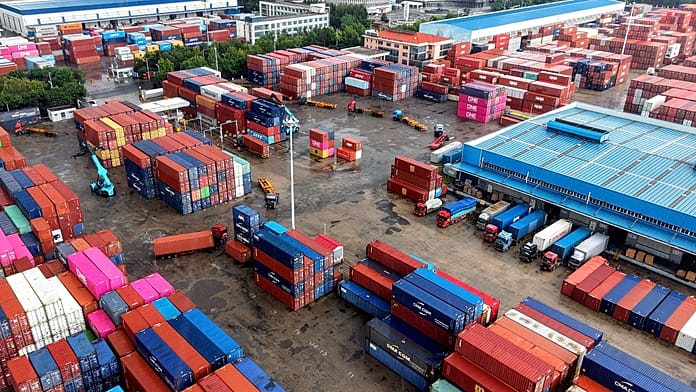
Driven by strong exports, China's economy expanded 4.5% in the July-September quarter from a year earlier. The official figure, announced on Monday, beat expectations and moves the country closer to its annual growth target, just as trading partners press harder to narrow their deficits with Beijing.
Growth in the previous April-June quarter was 4.3%, the slowest pace in more than three years. By comparison, the pace has picked up slightly this time.
Chinese leaders have set a 2026 target of 4.5%-5%, down from last year's 5% expansion. Earlier this month, the International Monetary Fund (IMF) cut its forecast for China's growth this year to 4.5%, the bottom of Beijing's range.
Exports remain one of the few bright spots. After a 36% jump in exports last month and a $938 billion surplus for January-September, China is on course to top last year's record $1.2 trillion trade surplus.
Higher US tariffs have dented bilateral trade, pushing Chinese exporters toward Southeast Asia, Latin America and Europe. High-tech goods, including semiconductors and hybrid and electric vehicles, are leading the growth.
In pursuing self-sufficiency to guard against Western export controls, China has built vast, heavily subsidised manufacturing capacity in sectors such as solar and EVs. But there have also been issues.
Output expanded quickly while consumption lagged, so much of it is sold abroad at competitive prices. Ecaterina Bigos, senior market strategist at BNP Paribas Asset Management, said this tech-driven, export-reliant model has produced limited job creation and income gains, while the risk of AI-driven job losses is growing.
According to Max Zenglein, Asia Pacific senior economist at The Conference Board, the headline official growth figure is becoming 'an increasingly poor indicator of how the broader economy is performing'. Despite the impressive number, he believes it hides 'widening disparities across industries, regions, and households', and that managing domestic imbalances may prove harder for Beijing than handling outside pressures.
Domestic demand has softened, weighed down by a years-long property slump that has eroded household wealth and pushed up savings.
The car export picture is also striking. China shipped about 919,000 passenger vehicles overseas in September, driven by strong foreign demand for plug-in hybrids and all-electric models, according to data from the China Association of Automobile Manufacturers. For the first nine months of 2026, exports topped 7.1 million passenger cars, a jump of more than 70% from the same period a year earlier.
However, fear that cheaper Chinese imports threaten their own domestic industries and trade balance continues to remain among Beijing's partners. The 27-nation European Union bloc runs a deficit with China of more than $1.1 billion (€981.2 million) a day, and Chinese exports to the EU rose 16% in the first nine months of the year.
Some member states want further curbs, even after an agreement this month to roughly halve Chinese hybrid vehicle imports over the next few years. That agreement saw the EU cap Chinese hybrid vehicle imports at 350,000 a year.
Analysts say China, however, can keep working with other countries on disputes while protecting its market access. Still, Lynn Song, chief economist for Greater China at ING, said trade imbalances 'will be difficult to resolve quickly'. Policymakers also argue that an undervalued yuan against the dollar and euro has fed the surplus, a claim China's central bank has rejected. Beijing has said it does not seek a large trade surplus. Last Friday, central bank governor Pan Gongsheng said deficit and surplus countries should cooperate and that China is committed to expanding domestic demand.