'We Brought Hell on Iran, We Could Be Tougher' — Trump Hints at Fresh Strikes After the Midterms, Tehran Warns Back
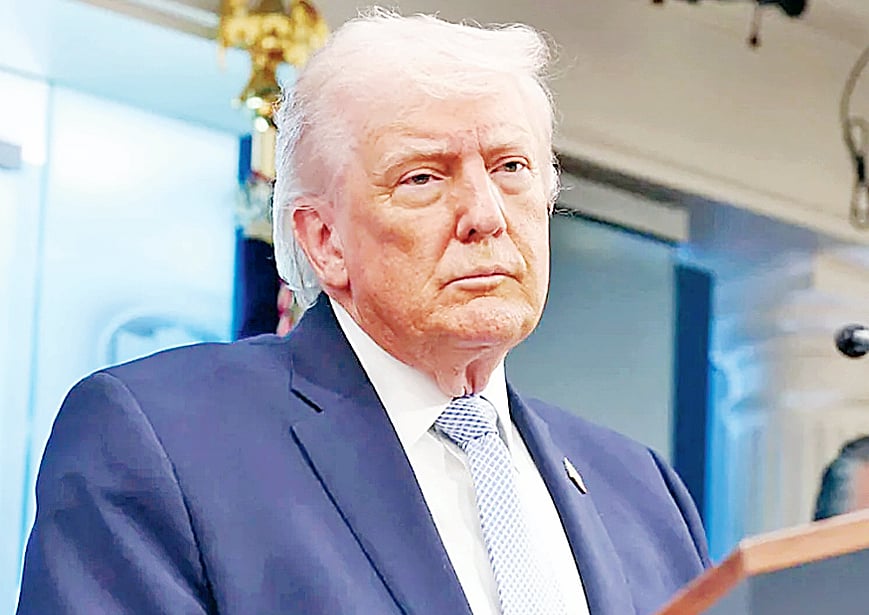
US President Donald Trump has hinted at resuming attacks on Iran. He said he had brought 'hell' down on Iran and could be somewhat tougher this time. Tehran, however, has said in advance that if attacks resume it will not stay silent either, and counterattacks will be carried out on US allies in the Middle East.
The New York Times has reported that attacks on Iran could resume after the US midterm elections. Trump's remarks came amid that reporting.
The war began in late February with joint US and Israeli strikes on Iran, and later spread across the Middle East. Direct US-Iran exchanges have currently paused, but Saudi Arabia's conflict with Yemen's armed Houthi group continues, and ships are regularly being attacked in the Strait of Hormuz, a vital energy shipping route. It is because of this conflict that many Saudi-bound flights from Bangladesh have recently been cancelled amid restrictions, leaving thousands of passengers stranded.
Analysts believe Trump has held back from the Iran war for now because of the way the conflict pushed up energy prices worldwide. Rising fuel prices have also caused inflation in the United States, and there is discontent among US citizens over it. That is why Trump does not want to risk fresh attacks before the midterm elections.
But the New York Times report says the United States could resume attacks after the 3 November midterms. The plan would involve not only the US but also Israel alongside it. US Defense Secretary Pete Hegseth has discussed the matter with Israeli Prime Minister Benjamin Netanyahu.
On Thursday local time, the US president said Iran must not be allowed to obtain nuclear weapons under any circumstances. He said some people might not like the step, but many people and patriots support it, and previous presidents should have taken it. 'We brought hell on Iran. We could be a little tougher,' he said.
Iran has issued a stern warning of all-out retaliation across the Persian Gulf region if the US and Israel launch fresh attacks. In response to such an attack, Iran's Supreme National Security Council Secretary Mohsen Rezaei has threatened to destroy oil installations, undersea data cables, data centres and artificial intelligence (AI) infrastructure in at least seven Gulf countries.
Mehdi Mohammadi, an adviser to the speaker of Iran's parliament, said Trump and Netanyahu had agreed in principle on a new attack on Iran. But if attacked this time, Iran would treat it as a fight for existence. Tehran's new strategy would have no limits or red lines, and the war would therefore last longer than the enemy's calculations.
Amid these exchanges of threats, seven oil tankers were damaged by fire in a single night in the Strait of Hormuz. According to information provided by Iran on Thursday, three of the seven ships were damaged by naval mines in the strait, while Iran's Islamic Revolutionary Guard Corps (IRGC) directly attacked the other four.
Tehran said the ships were linked to the United States and were transiting the strait with Washington's encouragement. Attacks on so many ships in one day point to a major escalation.
The IRGC recently announced a new policy for confronting US aggression against Iran. Under that policy, imposing a maritime blockade on Iran will also be treated as an act of war.
All eyes are now on whether war spreads again in the Middle East after the 3 November midterms. Fresh attacks could affect fuel prices, air routes and Bangladeshi expatriates as well, it is feared.