Hispanic voters who helped bring Trump to power may now be turning away in Texas

In Texas's Rio Grande Valley, people were gathering before dawn for prayer at the tiny La Lomita Catholic Chapel. The whitewashed building, standing since the days of the American Civil War, sits only about 200 yards from the Rio Grande river itself.
The chapel's priest, Father Roy Snipes, has been here for almost half a century. Locally he is known as the Cowboy Priest, because he wears a Stetson instead of a priest's more traditional hat. During the first Trump administration, he resisted plans to take the chapel's land to build the border wall.
This time, at the early Friday service, his short sermon focused on the actions of Immigration and Customs Enforcement, known as ICE. Before about 30 worshippers, mainly Hispanic, he said there is no good excuse to detain, incarcerate and deport poor, good folks who are neighbours.
According to government figures obtained by the Deportation Data Project, Texas accounted for roughly one-third of all ICE arrests nationwide in July 2026, a larger share than any other state. That statistic has deepened anxiety among people in the border area.
In his sermon, Father Snipes said people were told the authorities would seek out, capture, detain and deport the worst of the worst. On the border, the cartel is the worst of the worst, so they thought that would be a good thing. But in reality, almost every day brings word of some ordinary person stopped on the way to work and detained.
After the service, two educators said many of their students have had to go back because their parents are being deported. One of their friends said the cruelty they are seeing is what is turning the tide, at least that is what she hopes.
Turning the tide politically is exactly what Democrats hope to do. In the midterm elections on November 3, they want to benefit from this change in Texas. But it will not be easy.
This stretch of the Rio Grande was once one of the busiest crossing points on the US-Mexico border. Under former President Joe Biden, hundreds of thousands of migrants came through here, with more than two and a half million apprehensions recorded in a single year.
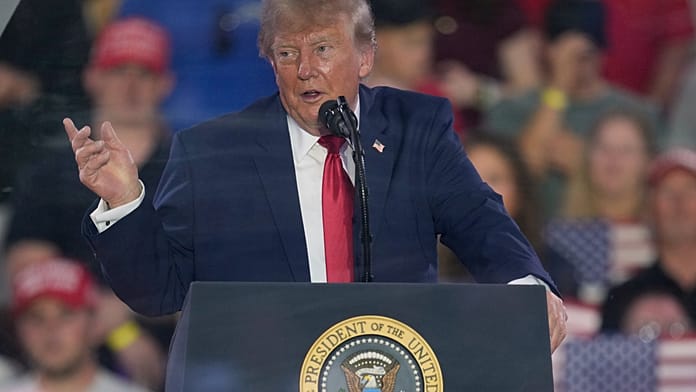
President Donald Trump promised during his 2024 election campaign to stop these illegal crossings, and in large parts he has delivered. Border crossings are now at their lowest level in decades. That promise partly drove Trump's astonishing level of support in the state; he took around 55 percent of Hispanic votes in Texas alone, a record for a Republican presidential candidate.
Javier Villalobos, the Republican mayor of McAllen, one of the biggest cities in the Rio Grande Valley, expects Republicans will find it tough this time, but he credits the Trump administration with stemming the border problem. He said most people are generally okay with deporting criminals, violent people or people who are not productive at all, but if productive and law-abiding people start being deported, that is where the problem is.
Recent polls suggest much of Trump's support among Hispanic voters has ebbed away since 2024. Surveys since late summer indicate a majority of Texan Hispanic voters disapprove of the president, and that Hispanic voters are favouring Democrats over Republicans by a significant margin.
Mario Guerrero, a young Mexican-American businessman who leads the South Texas Builders Association, voted for Trump three times in a row. But this November he is planning to vote Democrat. He said they voted for Trump after seeing an influx of immigration during the Biden administration, thinking he would fix the border crisis. But they were not told the extreme the administration was willing to go to in order to make a point.
Guerrero gave an example: a man he knows had 35 workers working for him every day last year; two days ago the man told him he would be lucky if four to six workers showed up. The immigration crackdown has directly hit the local labour market.
Yet Guerrero describes himself as neither Democrat nor Republican. According to Mike Madrid, a leading Republican consultant and expert on Hispanic voters, that is key: Latinos are more likely than any other racial or ethnic group to identify as independents rather than Republicans or Democrats.
It was partly the belief that Hispanic voters were shifting permanently towards the Republican Party that led Trump to press states such as Texas to redraw their congressional maps early, before the once-a-decade census. Texas's 15th congressional district was redrawn in 2025, creating a notional 18-point majority for Republicans, yet current polling suggests a Democratic lead of five or six points.
The Democratic candidate hoping to win that district is Bobby Pulido, a popular Tejano singer and winner of two Latin Grammys who is already a household name in the Rio Grande Valley. He has distanced himself from the national Democratic Party brand and focused deliberately on economic issues. In his words, this is not New York or Los Angeles; people want to hear about the economy first.
At a local avocado festival, Dave Baldwin and Veronica Salazar, when asked about the upcoming elections, immediately raised rising prices. Asked who they blame for spiking costs, their answer was swift: the president. Baldwin added that he is in control of their destiny in all that, and right now he is not doing a very good job.
Among many Republican campaigners there is a feeling they are on the back foot just weeks before the vote. Alexis Uscanga, a student volunteer knocking on doors to check on likely Republican voters, said the midterms are purely a game of turnout; it is about getting their own people to show up. On November 3, the Hispanic vote in Texas may therefore decide whether the map-redrawing strategy worked.