Rift Inside India's Election Commission Goes Public: Two Commissioners' Letters Sent Back to the Chief Himself
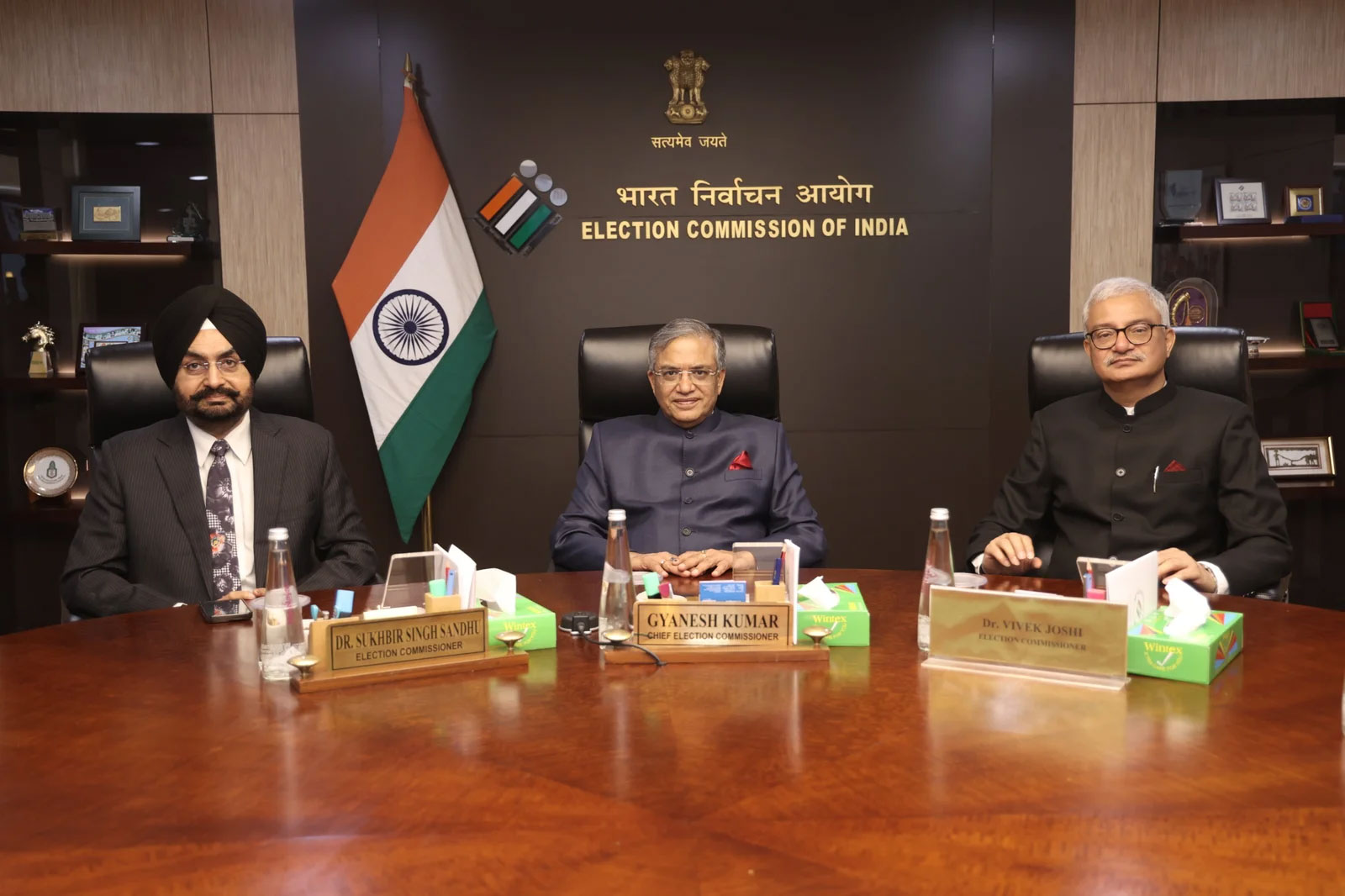
Internal discontent within India's Election Commission (ECI) has now come into the open through official documents. Letters written by two election commissioners about the Special Intensive Revision (SIR) of voter lists and the distribution of the Commission's internal work were, instead of being acted upon, sent to the office of Chief Election Commissioner (CEC) Gyanesh Kumar himself — the very person the objections centre on. The information has emerged from documents obtained under the Right to Information (RTI) Act.
The two election commissioners, Sukhbir Singh Sandhu and Vivek Joshi, had written to Cabinet Secretary T V Somanathan expressing concern over changes in the distribution of work and fears that an important oversight mechanism was being weakened.
The Indian Express had first reported the two commissioners' objections in an investigative report. About a month later, in response to an RTI application by retired Commodore and activist Lokesh Batra, it emerged that Cabinet Secretary Somanathan had acknowledged receiving the two commissioners' letters on 5 August. He then sought CEC Gyanesh Kumar's opinion on the matter. Whether the CEC replied to the Cabinet Secretariat is not known.
The RTI reply said Somanathan had treated the two commissioners' letters as communications sent in their 'personal capacity'. His position was that while the letters were considered with importance, they could not be regarded as the Election Commission's collective formal position.
In the same letter, however, Somanathan cited Section 18 of the 2023 Act on the appointment, conditions of service and tenure of the Chief Election Commissioner and other Election Commissioners. That section states that decisions on the Commission's business should be taken unanimously as far as possible, and where there is a difference of opinion, by majority. The Commission may also determine its own procedure by unanimous decision.
Somanathan himself noted that the Chief Election Commissioner and the other Election Commissioners enjoy equal status, and decisions must be taken unanimously or by majority opinion. In a three-member Commission, two election commissioners objecting on the same issue represented the majority view.
The RTI reply also released copies of the two separate letters written by Sandhu and Joshi on 29 July. Both letters objected to the distribution of administrative work by the Commission's Senior Deputy Election Commissioner, Manish Garg.
The background is that, as Deputy Election Commissioner in charge of the administration division, Bhanu Prakash Yeturu, went on leave from 27 July to 9 August, Garg was given additional charge of the division. Within hours of receiving the charge on 28 July, Garg issued an order redistributing work among the Senior Deputy Election Commissioner, Deputy Election Commissioners, Directors General and officers of equivalent rank.
Sandhu complained that neither the Election Commission nor he was informed before the order was issued, and no discussion or approval of the Commission was taken. Yet the officers concerned had repeatedly been instructed, verbally and in writing, that no such step could be taken without consulting the Commission.
According to Sandhu, Yeturu had issued no work-distribution order before going on leave, nor had his designated link officer Sanjay Kumar. But on 28 July the link officer charge of the administration division was suddenly handed to Garg, who issued the new order within hours of taking over. Sandhu wrote that Garg distributed the work of officers senior and equal in rank to himself as well as his own, which was contrary to the Commission's established practice and a violation of Sections 18(1) and 18(2) of the Act.
In a separate letter to the Cabinet Secretary the same day, Vivek Joshi raised the same objection. His language was almost identical to Sandhu's, but he made one additional complaint — that even when he asked the administration division to show him the relevant file, it was not given to him.
The Indian Express had earlier reported that the change in work distribution had effectively removed an important layer of oversight over the technical infrastructure of the voter lists. In their letters, the two commissioners also expressed concern about the reliability of the voter-related software ECINet.
According to a Hindustan Times report, the files of the Director General of the IT division used to be routed through Deputy Election Commissioner Sanjay Kumar. Under Garg's order, Sanjay Kumar was removed from that responsibility and Garg himself began overseeing the files. The investigative report also said a system had been introduced under which key officers could not directly access the voter database.
After the Indian Express report was published, the Election Commission issued a statement claiming that the order to remove Sanjay Kumar and route files through Garg 'was never actually implemented'. However, Hindustan Times reported that Sanjay Kumar was sent back to his home state cadre in August, after which IT division Director General Seema Khanna's files were routed to the commissioners through Garg.
The two election commissioners' letters, their objections to the work distribution, and the reports on the oversight structure over the voter database have raised major questions about administrative decision-making and the technical management of voter lists within India's Election Commission. This internal rift in the body that conducts elections in the world's largest democracy has now become a subject of political debate as well.