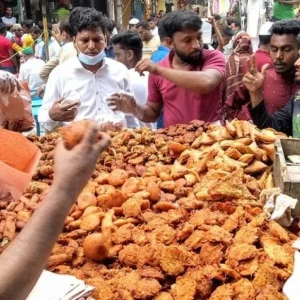
A single green coconut now costs Tk 150 to 200 in Dhaka, triple its Tk 60 price at the production area

Stopping at a roadside stall for a green coconut to quench one's thirst in the heat was once an everyday scene. Many bought coconut water for a sick relative or simply to refresh the body. That familiar picture is now changing — a single green coconut in the capital costs Tk 150 to 200, and many buyers turn away on hearing the price.
Visiting markets in Mohammadpur, Karwan Bazar and New Market on Wednesday morning (October 21) and speaking to buyers and sellers, it emerged that each coconut is now selling for Tk 150 to 200 depending on size and quality.
The effect of the price rise is not limited to buyers' pockets. Haggling is under way at coconut stalls while sellers try to explain why they must charge more — higher prices on one side and the pressure of persuading buyers on the other have created an unease in the coconut market.
Shahin Hawlader, a private-sector employee who came to buy a coconut in Mohammadpur's Town Hall area, said he used to buy one occasionally; now, hearing the price, he no longer feels like buying. Even when needed, buying every day is impossible — he has to balance it against other household expenses.
Another buyer in the same area, Ariful Islam, said the same coconut cost comparatively less only a short while ago; he was charged Tk 200 for a medium-sized one. If prices keep rising this way, he believes, ordinary people will find it hard to drink coconut water regularly.
Nula Akter, a housewife who came to New Market to buy a coconut for a sick family member, had the same experience. She said that when someone is ill, a coconut has to be bought on a doctor's advice or out of physical need, but at current prices buying regularly is very difficult — sometimes she has to cut other market expenses to afford one.
The question is why a coconut's price rises so much between the production area and the capital's retail markets. Wholesale sellers say a coconut is collected from tree owners in production areas for Tk 60 to 70. Adding labour wages, transport and warehouse costs, the price reaches about Tk 100 to 150 in Dhaka's wholesale market.
After shop rent, other operating costs and profit are added, the same coconut sells at retail for Tk 150 to 200 — meaning buyers pay Tk 80 to 140 more than the initial collection price, two to three times as much. Not all of that increase is traders' profit, however: at every step of the supply chain, transport, labour, loading and unloading, storage and operating costs are added, and because the product is perishable there is a risk of loss if it is not sold in time.
Sellers' arithmetic is not easy either. Farid Bepari, a coconut seller at Karwan Bazar, said that to the wholesale purchase price must be added transport, labour wages, shop rent and other costs. But if buyers refuse to buy on hearing the price, losses loom; unsold coconuts left in the shop lose freshness and some spoil. In his words, higher prices do not always mean higher profits for sellers.
Shajahan Bepari has long traded in the Town Hall area of Mohammadpur, bringing coconuts from Bhola district. He said not all coconuts are priced the same — price depends on size, water content and quality, and larger coconuts hold more water so they cost more. When prices are high, many buyers look for small coconuts instead of large ones, and some leave without buying at all, which cuts sales and makes it hard to recover costs.
Demand for coconuts rises further during dengue and other illness seasons. A dengue patient can become dehydrated; diarrhoea and other waterborne diseases also drain water and minerals from the body. Interest in coconut water as a natural drink therefore grows, and many families buy it regularly for a patient's recovery — but the high price then becomes an extra burden.
Nutritionist Seheli Sarkar Rodela said coconut water is a nutritious drink containing potassium and other minerals that can help maintain the body's fluid and electrolyte balance. But it should not be seen as a treatment for any disease or a substitute for oral saline. For a dengue or diarrhoea patient, fluid intake must be ensured on a doctor's advice, considering age, physical condition and the level of dehydration — and medical care must be sought quickly if severe dehydration appears.
SM Nazer Hossain, vice-president of the Consumers Association of Bangladesh (CAB), said buyers should have the opportunity to know why and by how much a product's price rises on its way from the production area to the capital's markets. According to those concerned, keeping coconut prices within ordinary people's reach first requires clearly identifying the price increase at every step, from the tree owner's price to the wholesale warehouse and the retail market.