US Supreme Court to hear case on race in middle school admissions
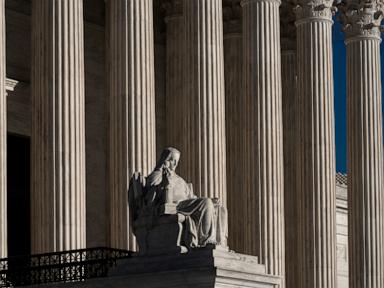
The US Supreme Court has agreed to hear a case about the role race plays in middle school admissions. The court took up the case on Monday — three years after a majority on the high court struck down affirmative action in college admissions, the question of race in education is back before the justices.
The case involves admissions to four selective middle schools in Montgomery County, Maryland, a diverse suburb of Washington, D.C. A group of parents said in a lawsuit that the district's admissions policy is designed to boost the admission of Black and Latino students while disadvantaging Asian American children.
The high court will now weigh whether the parent group has enough evidence of discrimination for the case to move forward. The case was originally dismissed because Asian American students were not underrepresented compared with their share of the applicant pool.
The justices will consider whether a group claiming to be targeted by a race-neutral policy must show it was disproportionately harmed in order to prove intentional discrimination.
If the court rules for the parent group, the Association for Education Fairness, it could revive the lawsuit — which is why the ruling's impact is expected to reach well beyond a single school district.
The lawsuit originates from a change in admissions policy that began a decade ago, when a consulting group was hired to evaluate how the school system chose students for its middle school magnet programs. The district then changed its admissions policies, factoring the poverty levels of the schools the students attended into the process. The share of Asian American students, who were clustered in more affluent, high-performing schools, subsequently fell.
The parent group sued in 2020. Not long after, the school system, which educates more than 150,000 students, changed its admissions practices again to eliminate an extra in-person exam. Now, students qualify for a lottery according to their performance on standardized tests. But students in more affluent schools, where Asian American students are concentrated, must perform better on the standardized exam to enter the lottery.
The Fourth Circuit Court of Appeals affirmed a lower court's decision to dismiss the case. In its ruling, the court said the parent group had failed to show that Asian American students were harmed, because they were still being admitted at higher rates than the applicant pool.
The Fourth Circuit was relying on a recent ruling in a different school admissions case, where parents challenged admissions practices at a highly selective magnet high school in Virginia. Those parents lost in part because Asian American students were still overrepresented relative to the applicant pool.
The attorneys for the Montgomery County parents argued it is not enough to compare whether a targeted racial group is represented fairly compared with the group of students who apply. Other evidence of discrimination should also be considered, they wrote.
"Under the applicant pool benchmark, the government can set specific racial targets, hit them, and avoid even an inquiry into discriminatory intent," the parents' lawyers wrote in their appeal to the Supreme Court, so long as it has not explicitly called out race in its process.
The school system has consistently argued the new admissions policy, called the Pandemic Plan due to the timing of its release, is race-neutral. "The Pandemic Plan is a colorblind lottery," attorneys wrote in a brief asking the Supreme Court not to take up the case. "Nothing about the Pandemic Plan, its history, or its purpose is offensive to the Constitution."
The court is expected to hear arguments in the coming months. School districts across the United States will be watching the hearing and the ruling that follows, because it could draw new lines around the role of race in admissions policy.